Skip to the main content.
Give Give Monthly
Give Give Monthly

2 min read

Cultivating Christmas Wonder

Cultivating Christmas Wonder

Author: John Stonestreet and Andrew Carico

Decades before our contemporary culture wars and complaints about its commercialization, T. S. Eliot described various perspectives about Christmas in his poem, “The Cultivation of Christmas Trees.” It is worthy of Advent reflection:  

There are several attitudes towards Christmas, 
Some of which we may disregard: 
The social, the torpid, the patently commercial, 
The rowdy (the pubs being open till midnight), 
And the childish—which is not that of the child 
For whom the candle is a star, and the gilded angel 
Spreading its wings at the summit of the tree 
Is not only a decoration, but an angel.   

The child wonders at the Christmas Tree: 
Let him continue in the spirit of wonder 
At the Feast as an event not accepted as a pretext; 
So that the glittering rapture, the amazement 
Of the first-remembered Christmas Tree, 
So that the surprises, delight in new possessions 
(Each one with its peculiar and exciting smell), 
The expectation of the goose or turkey 
And the expected awe on its appearance,   

So that the reverence and the gaiety 
May not be forgotten in later experience, 
In the bored habituation, the fatigue, the tedium, 
The awareness of death, the consciousness of failure, 
Or in the piety of the convert 
Which may be tainted with a self-conceit 
Displeasing to God and disrespectful to children 
(And here I remember also with gratitude 
St. Lucy, her carol, and her crown of fire):   

So that before the end, the eightieth Christmas 
(By “eightieth” meaning whichever is last) 
The accumulated memories of annual emotion 
May be concentrated into a great joy 
Which shall be also a great fear, as on the occasion 
When fear came upon every soul: 
Because the beginning shall remind us of the end 
And the first coming of the second coming. 

Eliot’s poem identified two perspectives Christians should adopt about Christmas. The first is “wonder,” like that of a child arrested before a Christmas tree. According to classical educator David Diener, “wonder” means recognizing ignorance and responding with a longing to know, in simplicity to mystery. Put differently, to “wonder” is a rich, human activity where we marvel at what we do not yet know. 

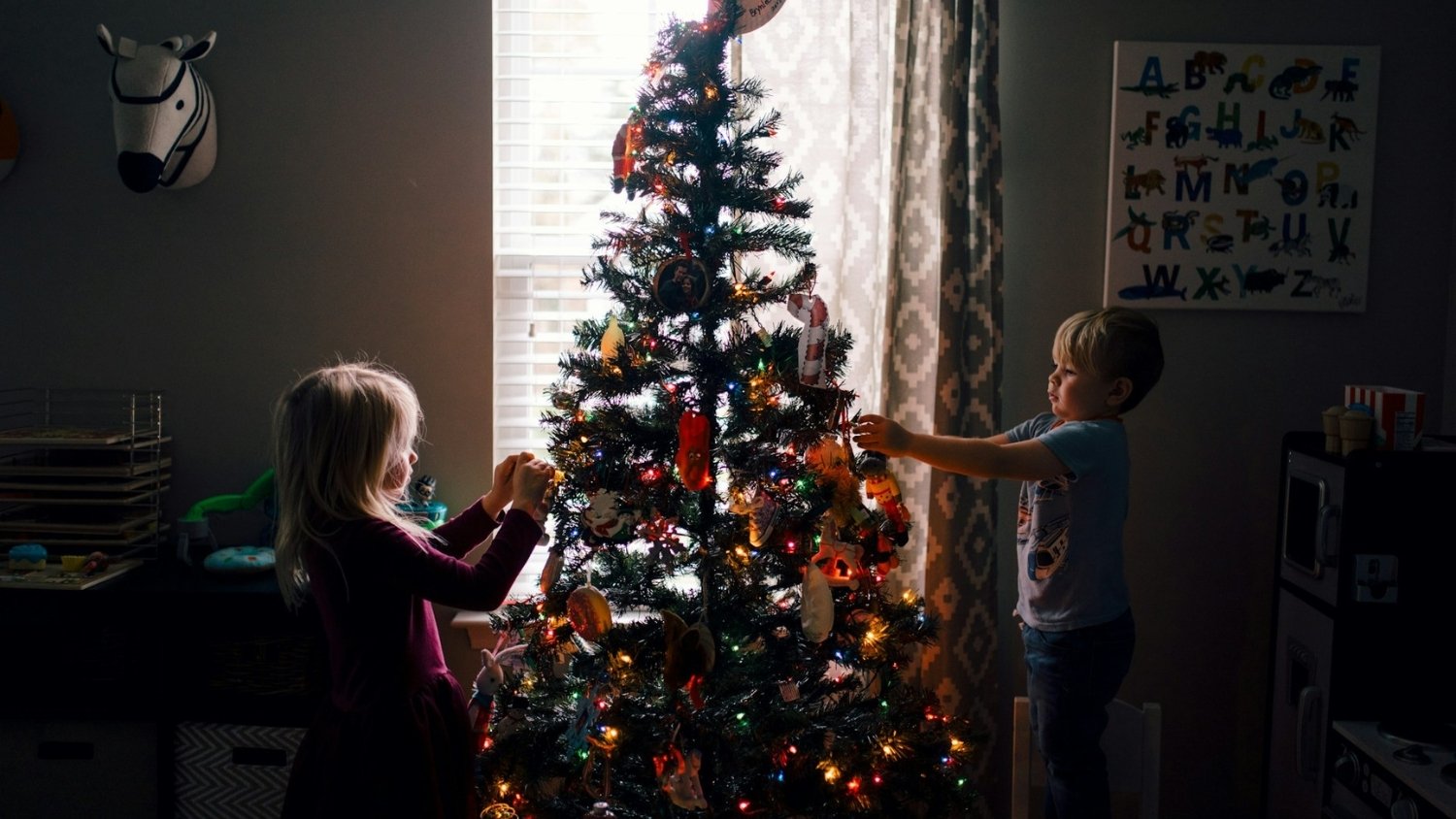
As Eliot captures in his lines: “The child wonders at the Christmas Tree: Let him continue in the spirit of wonder.” How often, in education or even by the Church, is a child’s beautiful ability to wonder at the truth of Christmas dismissed or squashed? How quickly do adults gloss over the incredible miracle of Emmanuel, God coming to dwell with us, a reality that left Shepherds and wise men marveling in wonder? 

Eliot also recommends another aspect of childlikeness, that of waiting in expectation with the goal of the day being fulfilled. While adults wrestle with the challenges of Christmas preparation, Eliot reminded readers that “(t)he accumulated memories of annual emotion may be concentrated into great joy.”  

Of course, as C.S. Lewis noted in an epigraph to The Abolition of Man, there is a dark side to Christmas. Eliot also emphasizes this point, reminding readers of the “fear” in the Christmas story: Mary’s encounter with Gabriel, the shepherds’ quaking at the angels, Joseph’s life-altering dream, or Herod’s order to slaughter all male infants. 

Only Christ can bring lasting peace on earth and goodwill toward men. He called for childlike faith, and the childlike wonder of Christmas offers a powerful posture for all of us. Childlike faith involves humility to trust in our Savior, who descended from Heaven, took the form of man, overcame sin, and is restoring all things anew.  

Such childlike faith is not childish. As philosopher J.P. Moreland wrote, “To be a child in this sense is to be humble and willing to trust in or rely on others, especially God. The opposite of the child is the proud, stiff-necked person, not an intelligent, reasonable one.” 

A childlike faith will allow us to see Christ’s birth in view of His death and Resurrection, as well as our roles as reconcilers in God’s unfolding story of reality. We thus can live in view of His return and triumphant reign. As Eliot put it, may Christ’s first coming fill us with hope for His second, when every knee will bow and every tongue confess that Jesus Christ is Lord. 

This Breakpoint was co-authored by Andrew Carico.

The O Antiphons of Advent

The O Antiphons of Advent

Author: John Stonestreet and Dr. Glenn Sunshine

Read More
The Church Behind Bars

The Church Behind Bars

Authors: John Stonestreet and Dr. Timothy Padgett

Read More