

SCOTUS Decides Whether Christian Counselors will be Able to Help Children
Author: John Stonestreet and Ian Speir

2 min read
Breakpoint
:
April 1, 2026
Author: John Stonestreet and Ian Speir
Colorado has extended its losing streak at the Supreme Court. Yesterday, the Court ruled in Chiles v. Salazar, a case that challenged a law that prohibited licensed counselors from helping clients, specifically children, reconcile their identity with their sex through talk therapy. The 8-1 decision included all of the Court’s conservative Justices and two of its liberal Justices. Because Colorado’s law would restrict speech based on viewpoint, the Court held, it violates the First Amendment.
The plaintiff in the case is Kaley Chiles, a Colorado-based counselor who provides talk therapy to her patients. As the Court explained, talk therapy is speech. It does not involve physical treatments or medical prescriptions. It consists only of “the spoken word.”
In counseling patients, including children, Chiles often discusses issues of sexual orientation and gender identity. Under Colorado’s law, Chiles could express “acceptance” and “support” of a child’s “identity exploration.” She could even “assist” a child in transitioning his or her “gender.” However, she was forbidden from saying anything to “change” sexual orientation or helping a child feel comfortable with his or her God-given sex.
That, the Court recognized, is flat-out viewpoint discrimination. Justice Gorsuch, who wrote the majority opinion for the Court, called Colorado’s law an “egregious” and “blatant” violation of the First Amendment. And even Justice Kagan agreed. In a short concurring opinion joined by Justice Sotomayor, the liberal Justice called this a “textbook case” of viewpoint discrimination. The law, she said, “distinguishes between two opposed sets of ideas—the one resisting, the other reflecting, the State’s own view of how to speak with minors about sexual orientation and gender identity.” On such an ideologically charged issue, the First Amendment does not allow Colorado to enable speech on one side and restrict it on the other.
In a futile attempt to defend its law, Colorado argued it was regulation of “professional speech” which, it said, should receive less First Amendment protection. The Court rejected that argument. The First Amendment protects everyone. Licensed professionals are not second-class citizens, nor should they be treated as such by the law.
That point is an incredibly important aspect of this particular ruling. After all, a free society requires that professionals are able to speak freely. Think of recent studies such as the UK’s Cass Review or the review from the U.S. Department of Health and Human Services, which exposed the overall lack of evidence for the effectiveness of gender dysphoria “treatments,” such as cross-sex hormones, puberty blockers, and surgical removal of healthy body parts. If the government can punish professionals for publishing and speaking about these topics or expressing viewpoints the government disfavors, science becomes politicized, truth is suppressed, and people (especially children) suffer real harm. As the Court put it, “the people lose whenever the government transforms prevailing opinion into enforced conformity.”
That is precisely what Justice Jackson, the sole dissenter on the Court, hoped would happen. In her view, the State should enforce its opinion under the guise of licensing standards and medical treatment. None of the other Justices, even the progressive ones on the Court, were willing to sacrifice the First Amendment in that way.
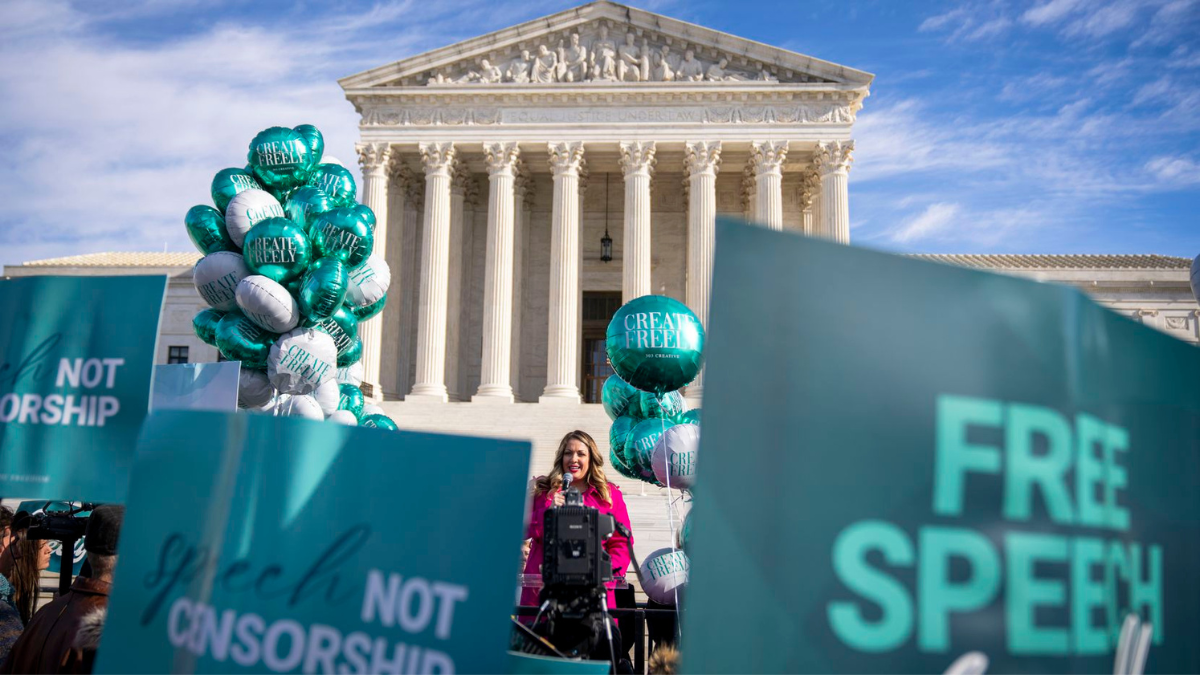
Chiles v. Salazar is the latest in a string of losses suffered by Colorado at the High Court. In Masterpiece Cakeshop, the Court found that Colorado officials violated the First Amendment when they expressed overt hostility toward the Christian beliefs of cake artist Jack Phillips. In 303 Creative, the Court rebuffed Colorado’s effort to compel Christian web designer Lorie Phillips to engage in speech celebrating same-sex marriage.
After Chiles, Colorado is now 0-3 in First Amendment cases. You’d think by now the state would have learned to respect the constitutional rights and religious convictions of its citizens. For now, we can be grateful for the Supreme Court’s affirmation that Christian counselors like Kaley Chiles and other professionals have a right to speak, even in professional contexts, in accordance with their consciences and sincerely held religious beliefs.
Author: John Stonestreet and Ian Speir
Authors: John Stonestreet | Dr. Heather Peterson On Friday, the Supreme Court delivered a smashing victory for free speech. Lorie Smith is the...
Authors: John Stonestreet and Maria Baer