Skip to the main content.
Give Give Monthly
Give Give Monthly

2 min read

Os Guinness on the Founding of the Republic

Os Guinness on the Founding of the Republic

Author: John Stonestreet, Dr. Timothy D. Padgett, and Os Guinness

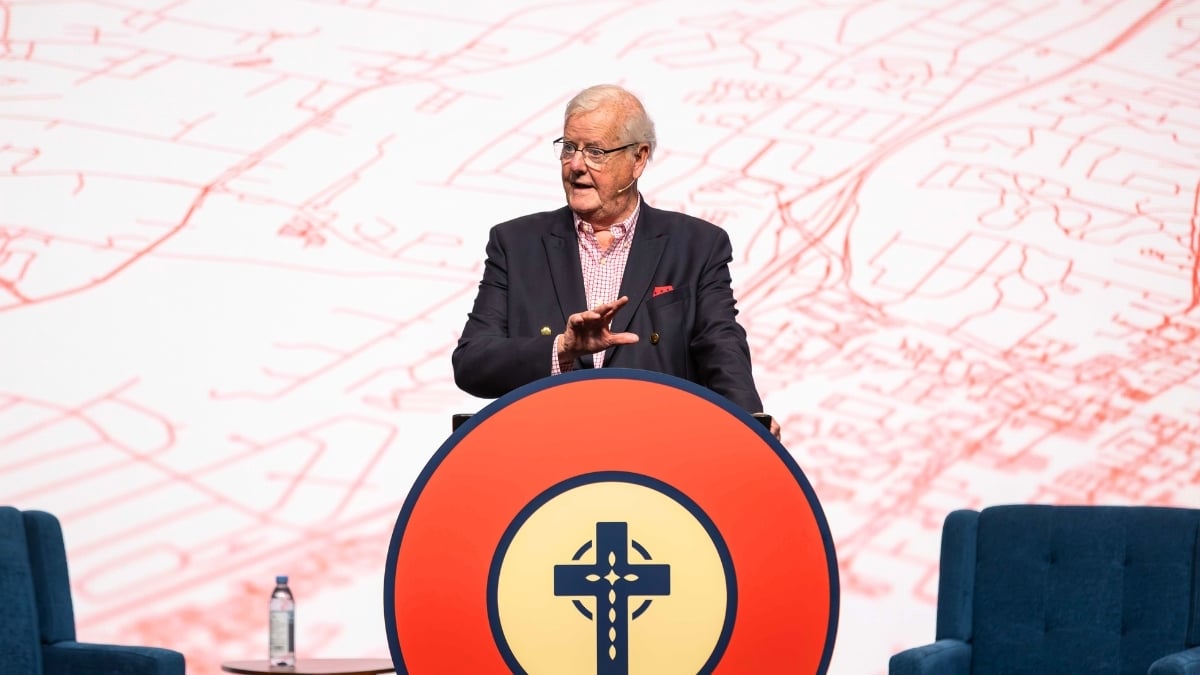
In this polarized age, one thing all sides agree on is that the state of the union is not strong. At the recent Colson Center National Conference, noted speaker, author, and Wilberforce Award winner Os Guinness argued that the best way forward is to look backwards, at what made the Republic what it became in the first place. 

Here’s Os: 

We have those who understand America from the perspective of the American Revolution in 1776. But large swaths of this country don’t understand America from the perspective of ideas coming down from the French Revolution in 1789, higher education, and many other spheres. There are ideas abroad entirely opposed to the Republic. 

Then again, in more ordinary circles, you can see the ignorance of what the Republic is. “Make America Great Again,” some people say. “Restore the Soul of America,” President Biden said. Now Biden never said what the soul was. But have you heard many people who praise MAGA in saying what made America great in the first place? Very few of them know what that was. 

How can you restore the Republic and make America great again unless you know what it was built to be and established to be? It was truly, with flaws, a freedom like no other. 

Yet today, there are few champions of it at a time when the global menace is unbridled power. You take the shifting of the platelets, as people talk about it, the shift from the weak gods of tolerance and so on, to the strong gods of blood and nationalism. You take the shift from the West to an increasing concentration on the world's greatest landmass, Eurasia, with the authoritarian Putin in the West and the totalitarian Xi Jinping in the East.  

Nietzsche, in the very last words that he ever wrote, says this: "Do you want a name for my world? This world is the will to power and nothing besides." He was attempting what he called the revaluation of all values, overturning the Jewish and Christian critique of power, and going back to the unbridled pagan view of power. That's our world. 

The only counter to it is the biblical understanding—the best attempt the American Republic was set up to be. 

Who champions that today? I only know one of all the congressmen I know, which is a good many, who actually speaks on it. So not many champion this, to put it mildly.   

The tragedy is that the forgotten key should be one we all know well, because it's biblical. In the 17th century, there's a rediscovery through the Reformation of what they called the Hebrew Republic. And what's the Hebrew Republic? Hierarchical? Based on power? No. It’s based on covenant—the notion of covenantalism is what shaped so much of the rise of modern freedom. Now we need to see that Sinai, the covenant at Sinai, is truly a singularity. There are other covenants outside the Bible, like the Hittite treaties, and covenants elsewhere in the Bible, like the covenants with Noah and Abraham. They're different.  

The Sinai covenant has a distinctive uniqueness. God is a partner to the covenant. It is with the whole of the people, not just between leaders. And it covers the whole of life. And that notion, as the reformers wrestled with the notion of covenantalism, came down in very practical ways to shape their understanding of politics. They wanted the consent of the governed.  

Where did that come from? Exodus. When the Lord proposes His covenant, He doesn't impose it, He proposes it. And three times it says in Exodus, "All that the Lord says, we will do . . .” This is what Michael Walzer of Princeton calls an “almost democracy.” 

The consent of the governed is mentioned in your own Declaration of Independence, but it goes back to Exodus. The covenant, of course, is a morally binding pledge; not a legal contract. No, no. It's a morally binding pledge; what many centuries later Martin Luther King would have called a promissory note in terms of the Constitution and the Declaration. It needed to be cashed in, but it was a promise made and a promise to be kept. 

That was Os Guinness. For access to the recordings of the entire conference, including a complimentary video of the incredible keynote presentation from Chloe Cole, visit colsoncenter.org/July.


Jimmy Lai and the Cost of Convictions

1 min read

Jimmy Lai and the Cost of Convictions

Author: John Stonestreet and Dr. Timothy D. Padgett

Read More
How Liberty Dies in Belgium or the U.S.

1 min read

How Liberty Dies in Belgium or the U.S.

Authors: John Stonestreet | Dr. Timothy D. Padgett This week, police in the city of Brussels shut down access to the NatCon conference. The official...

Read More
Dangerous Liberty and the Safety in Silence

1 min read

Dangerous Liberty and the Safety in Silence

Authors: John Stonestreet and Dr. Timothy D. Padgett

Read More